Inbox Zero in 2026: What It Really Means and How to Get There
Written by Viraj Pandit
Almost everything you have read about inbox zero gets it wrong in the same way, and the mistake is not the one you think.
Yes, the well-worn correction is true: the "zero" was never about the number of messages in your inbox. Merlin Mann, who coined the term on his blog 43 Folders in 2006 and popularized it in a Google Tech Talk in 2007, meant something closer to attention. In his words, the zero was about how much of your own brain is in that inbox. Not the count. The occupation.
That much is now widely repeated. Here is the part almost nobody follows through on: having corrected the definition, every inbox zero guide then hands you a manual ritual and asks you to be more disciplined. Process every message. Touch each one once. Delete, delegate, respond, defer, or do. Clear it daily.
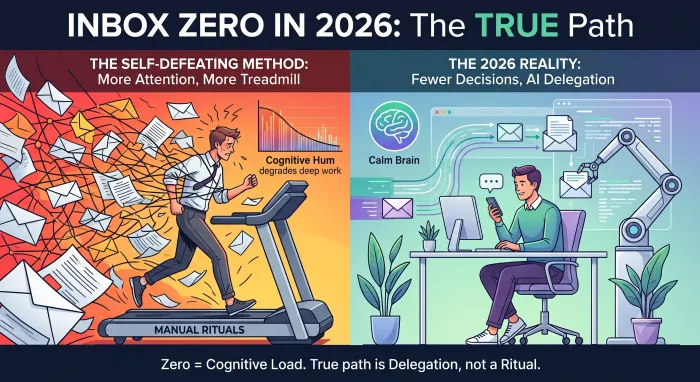
Look at what that actually proposes. The goal is to spend less of your attention on email. The method is to spend more attention on email, just more efficiently. You cannot reach zero attention by paying more attention. That contradiction sits at the heart of nearly every version of this idea, and it is why so many people conclude that inbox zero does not work.
It works. The methods built on top of it are what fail. This guide covers what Mann actually said, why the rituals collapse, and what genuinely delivers his version of zero in 2026.
Merlin Mann's original idea
Mann introduced inbox zero in a 2006 series of posts and brought it to a wider audience in a July 2007 talk at Google that has since been viewed millions of times. His argument was sharper than the slogan it became.
Email, he said, had become a surrogate for productivity. Checking, filing, replying, and organizing felt like work while producing nothing. The zero he proposed was a measure of cognitive load: the time your brain spends in the inbox, and the unresolved threads it keeps prying back open. An empty inbox was, at most, a side effect. The real target was the absence of unresolved attention.
He also laid out a short set of principles, sometimes called his articles of faith, and they hold up better than the method that followed:
- Some messages matter more than others, and on any given day only a handful are important and timely.
- Your time is finite and valuable, so stop treating each email as something to savor.
- Shorter replies are usually better replies.
- Do not feel guilty about a full inbox.
- Be honest about your priorities and your capacity, rather than pretending you will answer everything.
Read them together and a clear position emerges: email is a communication channel, not a to-do list, and it deserves a fraction of the attention people give it.
The misreading that built an industry
The productivity world heard "zero" and pictured an empty screen. What followed was fifteen years of a corrupted version: the empty inbox as a status symbol, a screenshot, a thing to brag about. Chasing that number became a discipline in its own right, one that consumed the very attention Mann wanted people to reclaim.
Mann himself has pushed back on the literal reading repeatedly, and in a 2020 revisit he confirmed he does not keep his own inbox empty and described the popular interpretation as a misreading. The person who invented inbox zero does not practice the version the internet sells.
The cost of the misreading is real. People who chase a permanently empty inbox report more stress, not less, and when the count creeps back up, as it always does, they conclude the method is broken. The method was never the problem. The interpretation was.
The treadmill problem
There is a structural reason the empty-inbox version cannot work, and it is worth stating plainly: you cannot stay at inbox zero.
The productivity writer Chris Bailey put his finger on it. The moment you clear your inbox, the emails you just answered start generating replies. Your diligence creates your next backlog. Reach zero at 6pm and you have a fresh pile by morning, partly because you were efficient.
Add the modern context and it gets worse. Mann was writing for a world with one inbox. Most professionals now run several email accounts plus Slack, texts, and notifications, and hitting literal zero across all of them is a full-time job that produces nothing. Meanwhile the volume has not moved: McKinsey's widely cited research put email at roughly 28% of the workweek, and that number has proven stubborn.
So the empty-inbox target is not just a misreading. It is a treadmill that runs faster the harder you work.
The cost is the ritual, not the email
It is worth being precise about what email actually costs you, because the number people quote is the smaller half of the problem.
The headline figure is time. McKinsey's research put reading and answering email at roughly 28% of the workweek, more than a full working day gone every week. That alone justifies almost any tool that reliably claws back part of it.
But Mann's insight was that the time is not the expensive part. The expensive part is the residue. An unanswered thread does not stop costing you when you close the tab; it stays half-open in your head, resurfacing while you are trying to do the work that actually matters. Twenty unresolved emails are not twenty minutes of pending work, they are a low background hum that degrades everything else you do that day. That is what he meant by how much of your brain is in the inbox, and it is why an inbox you cleared at 6pm can still occupy you at 9pm.
This reframes the whole calculation. A method that helps you process email 20% faster saves you a slice of the smaller cost while leaving the larger one intact, because you are still the one holding every open decision. The only thing that removes the residue is not holding the decision at all, either because the message never reached you, or because something else already dealt with it.
The classic method, and where it stops
The traditional inbox zero method is still worth knowing, because it is genuinely useful and because it is what most guides mean when they use the term. It goes like this: process your email in defined windows rather than continuously, and make one decision per message. Delete or archive what needs nothing. Delegate what belongs to someone else. Respond immediately if it takes two minutes. Defer what needs real thought to a task list with a date. Do the rest. Then close the inbox.
There is a lot right about it. Batching beats constant checking. One decision per message beats reading things four times. Getting tasks out of the inbox and into a real list respects Mann's point that email is not a to-do list.
But notice its ceiling. Every step is a decision you make, on every message, forever. It makes the processing efficient without making it smaller. For an inbox of thirty messages a day, that trade is fine. For an inbox of two hundred, mostly repetitive, the ritual becomes the job. As Peter Drucker put it, there is nothing so useless as doing efficiently that which should not be done at all.
Reaching zero attention without paying attention
The honest 2026 answer to Mann's goal is not a better ritual. It is fewer decisions.
That is a genuinely new possibility. For the whole history of this idea, the only way to clear an inbox was for a human to look at each message and decide. Software could sort and filter, but the judgment, and therefore the attention, stayed with you. That is no longer true. Language models can now read a thread, understand what it is asking, and act on it, which means the decision itself can be delegated rather than accelerated.
Three levels of help exist, and they map neatly onto Mann's principles.
Cut the volume. Mann said only a handful of messages matter on any given day. Filters act on that: a tool like SaneBox routes low-value mail out of your inbox before you see it, which is the cheapest possible reduction in attention because it removes the message, not just the work.
Rank what is left. Mann said some messages are more equal than others. AI triage does that better than folders, reading each message for urgency and intent and handing you an ordered list of what actually needs you today, rather than six categories you still have to open. Our guide to AI email triage covers how that works.
Hand off the routine. This is the step that has never existed before. An email agent reads incoming mail, drafts replies from your own templates, sends the routine ones, chases the threads that stall, and logs what matters, escalating only what needs a human. The mail is not organized for you to handle. It is handled.
That last level is what finally delivers Mann's zero as he defined it. Your brain is not in the inbox, because the inbox did not need your brain for most of what arrived. For how this category works, see our guide to AI email agents, for the tools that do each of these jobs, our tested guide to the best AI email assistants, and for the broader approach, AI email management.
A practical method for 2026
Combining Mann's principles with what software can now do, here is a version that holds up.
Stop targeting an empty inbox. Target a quiet mind. If the count matters to you emotionally, that is the ritual talking.
Cut the noise first. Before you optimize anything, remove what should never have arrived. Unsubscribe aggressively and let a filter handle the rest. Most inboxes shrink dramatically from this step alone.
Let software make the first pass. Have your mail ranked before you look at it, so you open your laptop to a short list rather than a pile.
Delegate the repeatable. Identify the mail that follows a pattern, the same questions, confirmations, and requests you answer weekly, and hand that category to an agent. Start in draft-only mode, expand once you trust it. See AI auto reply for how that works in practice.
Keep the judgment. Anything consequential, sensitive, or genuinely new stays yours. That is not a limitation, it is the point. Automate the repeatable, keep the judgment human.
Batch what remains. Two or three defined windows a day for the mail that needed you. With the first four steps done, this is a much shorter list.
Stop measuring the wrong thing. The metric is not messages remaining. It is whether email is on your mind when you are trying to do something else.
Is inbox zero still worth chasing
Yes, if you mean what Mann meant. No, if you mean the empty screen.
The empty-inbox version is a treadmill that punishes you for being productive and rewards you with a screenshot. The original version, an inbox that does not occupy your attention when you are not in it, is one of the most valuable states in knowledge work, and it is more achievable now than at any point since 2006, precisely because you no longer have to reach it by hand.
The irony is worth sitting with. Twenty years of methods asked people to become more disciplined processors of email. The thing that finally delivers Mann's goal is not being better at email. It is doing less of it.
Frequently asked questions
What does inbox zero actually mean? It refers to attention, not message count. Merlin Mann, who coined the term in 2006, defined the zero as the amount of your brain that is occupied by your inbox. An empty inbox was never the goal; a mind free of email was.
Is inbox zero realistic? The literal empty-inbox version is not sustainable, because clearing your inbox generates replies that refill it, and most people now manage several inboxes plus chat. The original version, an inbox that does not occupy your attention, is realistic, especially with filtering and automation doing the first pass.
Does Merlin Mann still practice inbox zero? Not the popular version. In a 2020 revisit he confirmed he does not keep his own inbox empty and described the empty-inbox interpretation as a misreading of what he meant.
What is the inbox zero method? The classic method is to process email in defined windows and make a single decision per message: delete or archive, delegate, respond if it is quick, defer to a task list, or do it. It is effective but has a ceiling, since every message still requires a decision from you.
Is inbox zero bad for productivity? Chasing an empty inbox can be, since it turns email processing into a status game that consumes the attention it was meant to free. Mann's own point was that email activity feels productive while producing nothing. The version that helps is the one that reduces how much you think about email.
Can AI help you reach inbox zero? Yes, and it targets the real problem rather than the ritual. Filters cut what reaches you, AI triage ranks what remains, and an email agent handles the routine replies and follow-ups outright, which reduces the number of decisions you make rather than making you faster at them.
The bottom line
Inbox zero was never about an empty inbox. It was about not carrying your inbox around in your head. The methods built on the misreading fail for a structural reason: they try to buy less attention with more attention, and the inbox refills the moment you win.
What has changed in 2026 is that the decisions themselves can be delegated. Cut the noise, rank what is left, hand the repeatable mail to an agent, and keep the judgment for yourself. Do that and you get the state Mann actually described, without the ritual he never asked for.
If your inbox is mostly repetitive business mail, inquiries, follow-ups, and leads that need logging, the fastest route to a quiet mind is not a better system for processing it. It is not having to.
References
- Mann, M. Inbox Zero, 43 Folders (2006) and Google Tech Talk (July 2007).
- Mann's 2020 revisit of inbox zero, in which he confirms he does not keep his own inbox empty.
- McKinsey Global Institute. The Social Economy: share of the workweek spent reading and answering email.
- Bailey, C. On the impossibility of remaining at inbox zero.