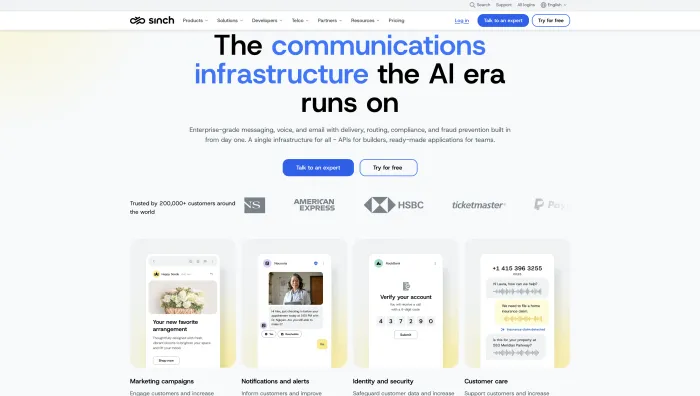
What Is Sinch?
Sinch is a cloud communications platform that provides APIs and tools for SMS messaging, voice, email, video, verification, phone numbers, WhatsApp, RCS, and customer engagement.
Businesses use Sinch to send OTP codes, transactional SMS alerts, marketing messages, appointment reminders, delivery updates, security notifications, customer support messages, WhatsApp campaigns, and voice calls.
In simple words, Sinch helps companies communicate with customers through channels like text messages, phone calls, WhatsApp, email, and RCS.
| Example Business | How It May Use Sinch |
|---|---|
| Fintech app | Sends OTP login codes, fraud alerts, and account security messages. |
| Ecommerce store | Sends order confirmations, delivery updates, and promotional SMS campaigns. |
| Healthcare provider | Sends appointment reminders and patient communication updates. |
| Marketplace | Masks numbers between buyers and sellers and routes communication safely. |
| SaaS platform | Sends account alerts, verification codes, and product notifications. |
Sinch Meaning: Why the Keyword Is Confusing
One unusual part of the SERP is the query “sinch meaning.” This happens because “Sinch” looks similar to “cinch,” a common English word meaning something easy or certain.
For this review, Sinch refers to the communications technology company, not the dictionary word “cinch.” If someone searches “Sinch” in a software, SMS, VoIP, or business communication context, they are usually looking for the company that offers communication APIs and customer engagement tools.
What Is Sinch Used For?
Sinch is used for customer communication, SMS campaigns, OTP verification, voice calling, phone number workflows, email sending, WhatsApp messaging, RCS campaigns, and omnichannel engagement.
- SMS OTP and phone number verification
- Two-factor authentication codes
- Transactional SMS alerts
- Marketing SMS campaigns
- Appointment reminders
- Order and delivery updates
- Customer support messaging
- WhatsApp business messaging
- RCS campaigns
- Voice calling and programmable voice
- VoIP phone number workflows
- Email communication
- Fraud prevention and identity verification
What Is Sinch VoIP?
“Sinch VoIP” is one of the most important related search intents. Many users see a phone number connected to Sinch and want to understand what it means.
A Sinch VoIP number usually refers to a phone number or voice communication route connected with Sinch’s voice or telecom infrastructure. Businesses may use Sinch numbers for calls, SMS, verification, customer support, number masking, or app-based communication.
What Is a Sinch VoIP Number?
A Sinch VoIP number is generally a phone number used through internet-based calling or cloud communication infrastructure connected with Sinch services.
Companies may use these numbers to place calls, receive calls, send SMS messages, verify users, route customer conversations, mask phone numbers, or manage customer support communication.
A Sinch VoIP number can be legitimate, but users should still be careful. If a call or message asks for a password, payment, OTP code, bank detail, gift card, or sensitive personal information, verify the request directly through the official company website or app.
Is Sinch Legit and Safe?
Yes, Sinch is a legitimate cloud communications company. It provides business messaging, SMS, voice, email, verification, video, and communication APIs.
However, “legit company” does not mean every message, phone number, or customer using Sinch infrastructure is trustworthy. A major theme in the user review records is that several reviewers believe Sinch-connected numbers are involved in spam calls, robocalls, scam calls, or harassment.
Those are serious user allegations, not proof that every Sinch customer behaves badly. From a buyer’s point of view, the key question is not only whether Sinch is a real company. The key question is how effectively Sinch handles abuse reports, spam complaints, suspicious numbers, and customer support escalations.
Sinch Products Explained
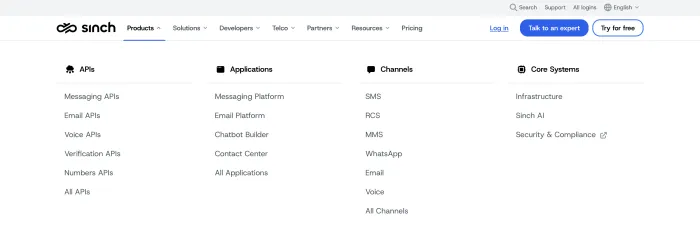
Sinch has a wide product ecosystem. This is useful for large businesses, but it can confuse new users.
1. Sinch SMS API
Sinch SMS API lets businesses send text messages programmatically through an API. Developers can connect websites, apps, CRMs, backend systems, or automation tools to Sinch and send messages to users.
Common SMS API use cases include OTP codes, login verification, delivery updates, appointment reminders, customer alerts, billing reminders, marketing messages, and security notifications.
2. Sinch Verification API
Sinch Verification API helps businesses verify mobile phone numbers and users. It can be used for OTP codes, authentication flows, and fraud prevention.
Verification is especially important for banking apps, fintech platforms, SaaS signups, ecommerce accounts, marketplaces, delivery apps, subscription products, and account recovery flows.
3. Sinch Voice API
Sinch Voice API helps businesses add programmable voice to applications. Companies may use it for calling, call routing, number masking, support flows, and voice-based customer communication.
4. Sinch Conversation API
Sinch Conversation API is designed for omnichannel messaging. It helps businesses send and receive messages across multiple channels without building separate workflows for each one.
5. Sinch Email
Sinch also offers email solutions. This can matter for companies that want email, SMS, voice, and verification under one communications provider.
6. Sinch Engage and MessageMedia
Sinch Engage is connected with MessageMedia. This matters because the SERP includes “Sinch MessageMedia login” and app results. Sinch Engage is used for SMS, MMS, WhatsApp, RCS, customer messaging, campaign workflows, inbox-style communication, and integrations.
7. Sinch Numbers
Sinch provides phone number services for SMS, voice, verification, routing, and customer communication. Number type, region, carrier rules, and compliance requirements can affect setup and cost.
Sinch Pricing in 2026
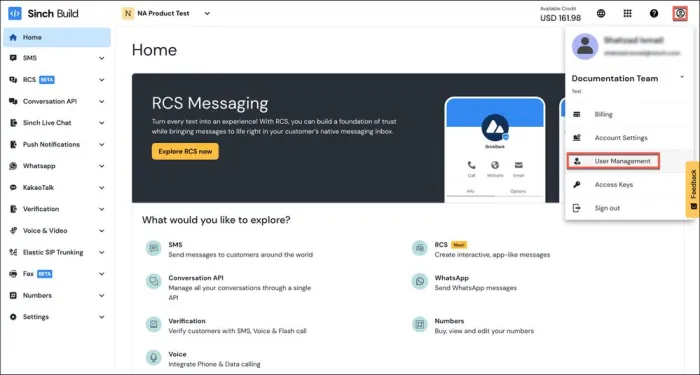
Sinch pricing is not easy to reduce to one number. The final cost depends on product, country, message type, number type, carrier fees, verification method, volume, compliance requirements, and support needs.
This is one reason pricing clarity gets a lower score in this review.
| Pricing Area | What to Check |
|---|---|
| Destination countries | SMS and voice costs can vary by country. |
| Monthly volume | Estimate normal, peak, and emergency sending volume. |
| Message type | SMS, MMS, RCS, WhatsApp, voice, and email can price differently. |
| Number type | 10DLC, toll-free, short code, and virtual number costs can differ. |
| Carrier fees | Some regions include additional carrier surcharges. |
| Compliance | Registration and approval may affect setup time. |
| Refund policy | Understand what happens if the account is blocked or not approved. |
| Testing limits | Confirm which countries and numbers can be tested before funding. |
Is Sinch Expensive?
Sinch can be affordable for some businesses and expensive for others. If you only send a small number of messages, the cost may be manageable. If you send high-volume SMS, international messages, OTP verification, WhatsApp campaigns, or voice traffic, costs can grow quickly.
The bigger issue from the review records is not only cost. It is cost plus friction. Users complained about duplicate SMS messages, funds added to accounts but services not being usable, refund refusal, blocked accounts after payment, account funding rejected without clear explanation, and support delays while costs continued.
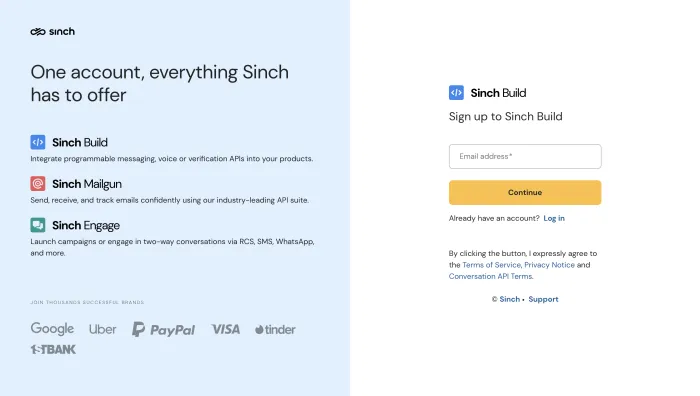
Real User Experience Patterns From 28 Review Records
We analyzed 28 user experience records shared for this review. One positive record appeared to refer to an e-bike named “Sinch,” not the communications company, so it should not be used as evidence for Sinch’s software.
Excluding that unrelated record, the review pattern is heavily negative.
The strongest repeated themes were poor customer support, slow response times, refund disputes, account approval problems, vague security checks, funding rejection, login confusion, duplicate SMS charges, integration workflow issues, downtime after migration, spam/robocall concerns, difficulty reporting abuse, difficulty testing voice/SIP services, and lack of clear communication from sales or support.
| Pattern | What Users Reported | Buyer Takeaway |
|---|---|---|
| Support delays | Users described slow responses, unresolved tickets, and weeks or months to fix issues. | High risk if messaging is mission-critical. |
| Onboarding friction | Several users said they could not fund accounts, pass security checks, or get approval. | Startups and new businesses may face approval friction. |
| Refund disputes | Some users said refunds were refused even when services could not be used. | Test with low risk and document every payment. |
| Duplicate SMS costs | One Zoho CRM user reported duplicate SMS caused by an automatically generated workflow. | Integrations must be tested carefully before production. |
| Login confusion | One user said there was no clear way to log in or see pricing after account creation. | Portal clarity may be an issue for some users. |
| Spam/robocall concerns | Several users accused Sinch-connected numbers of enabling spam or scam calls. | Abuse handling is a major trust concern. |
Positive Themes From User Records
The review data is mostly negative, but there are still positive signals. One relevant reviewer said Sinch has a very good API and that they use it for internal projects. This supports the idea that Sinch may be strong for technical users who successfully pass onboarding and connect the API properly.
- Good API potential
- Useful for internal projects
- Strong communication product range
- SMS, voice, verification, and messaging coverage
- Suitable for technical teams when setup works
Negative Themes From User Records
The negative review themes are much stronger and more detailed. Many users described support as slow, unhelpful, or difficult to reach. Some said issues took weeks or months to resolve. Others said support replied vaguely or refused to explain why an account failed security checks.
Several users said they were legitimate businesses but could not fund their accounts or pass security checks. Others complained about refund refusal, account funding problems, duplicate SMS costs, and difficult login or portal navigation.
Several reviewers also accused Sinch-connected numbers of being involved in spam calls, robocalls, scam calls, stalking, or harassment. These are user allegations, not proof that every Sinch customer behaves badly. Still, the pattern matters because a communications provider’s reputation depends heavily on abuse prevention and response quality.
Sinch Pros and Cons
Sinch Pros
- Strong SMS, voice, email, video, verification, and messaging product range
- Good API potential for technical teams
- Useful for SMS OTP and verification workflows
- Supports omnichannel messaging across SMS, WhatsApp, RCS, MMS, and more
- Sinch Engage and MessageMedia can support business messaging workflows
- Delivery reports and developer tools are valuable
- Suitable for enterprise-scale communication
- Can reduce vendor fragmentation across channels
Sinch Cons
- User records show serious support complaints
- Account approval and funding can be frustrating
- Pricing can be complex due to carrier, country, and number fees
- Several users report refund disputes
- Some users report login and portal confusion
- Integration mistakes can cause duplicate SMS costs
- Abuse and spam complaint handling is a trust concern
- Not ideal for casual testers or very small businesses needing simplicity
Sinch for Different Users
Sinch for Startups
Sinch can work for startups with serious communication needs, but the review records suggest early-stage companies may face onboarding friction. Some startup users said they could not fund accounts, could not pass security checks, or were rejected without clear explanation.
Sinch for Small Businesses
Sinch can be useful for small businesses through Sinch Engage or MessageMedia-style workflows, especially for SMS campaigns, appointment reminders, customer conversations, and promotional messaging. However, simpler SMS marketing tools may be easier if your needs are basic.
Sinch for Developers
Sinch can be good for developers because it provides APIs, SDKs, delivery reports, webhooks, and multiple communication channels. Developers should still test carefully before production because review records show problems around approval, country limitations, voice/SIP testing, support delays, and unclear rejection reasons.
Sinch for Enterprises
Sinch is most naturally suited for larger companies that need scalable communication infrastructure and have technical, compliance, and procurement resources. Enterprises should still test reliability, SLAs, support escalation, abuse handling, billing transparency, and migration planning before moving critical communication to Sinch.
Sinch for Ecommerce
Ecommerce companies may use Sinch for order confirmations, delivery updates, abandoned cart SMS, promotional campaigns, WhatsApp messages, customer service conversations, return updates, and loyalty campaigns.
Sinch for SaaS
SaaS companies may use Sinch for OTP codes, signup verification, login alerts, billing notifications, security alerts, product updates, and in-app communication. For SaaS teams, verification reliability and support response time are critical.
Sinch for Fintech
Fintech companies may use Sinch for OTP, fraud alerts, user verification, transaction notifications, and account security messages. Because fintech communication is sensitive, buyers should closely review delivery reliability, compliance, fraud prevention, support speed, and audit trails.
Sinch Safety Checklist Before Going Live
| Checklist Item | Why It Matters |
|---|---|
| Account approval confirmed | Avoid building around an account that later gets blocked. |
| Supported countries verified | Prevent failed SMS or voice testing in target markets. |
| Pricing confirmed in writing | Avoid surprise carrier or number fees. |
| Refund policy reviewed | Understand what happens if the service cannot be used. |
| CRM workflows tested | Prevent duplicate SMS messages and unnecessary costs. |
| API logs monitored | Detect failures, retries, and duplicate sends. |
| Backup provider ready | Protect OTP and critical messaging uptime. |
| Support escalation path confirmed | Critical if communication is mission-critical. |
Sinch Comparisons
Sinch vs Twilio
| Feature | Sinch | Twilio |
|---|---|---|
| SMS API | Strong | Strong |
| Voice API | Strong | Strong |
| Verification | Strong | Strong |
| Developer ecosystem | Good | Very strong |
| Ease for beginners | Medium-low | Medium |
| Best for | Enterprise messaging and broad communication needs | Developer-first communication APIs |
Sinch vs MessageMedia
MessageMedia is now connected to Sinch through Sinch Engage. Sinch is broader and more infrastructure-focused, while Sinch Engage or MessageMedia workflows are more campaign and business-user focused.
Sinch vs Mailgun
Sinch and Mailgun overlap around email, but they are not the same type of tool. Mailgun is mainly known for transactional email API and SMTP. Sinch is broader across SMS, voice, verification, messaging, email, and video.
Sinch vs SendGrid
SendGrid is mainly known for email API and email marketing. Sinch is stronger as a broader communications platform for SMS, voice, verification, and omnichannel messaging.
Best Sinch Alternatives
Twilio
Best for developer-first communications APIs, SMS, voice, verification, and broad integrations.
Plivo
Best for SMS and voice APIs with developer-friendly infrastructure.
Telnyx
Best for voice, messaging, numbers, and communications infrastructure with developer control.
Infobip
Best for enterprise omnichannel communication and global messaging.
SlickText
Best for simpler SMS marketing campaigns, especially for small businesses.
GatewayAPI
Best for businesses comparing SMS API providers with simpler setup needs.
LabsMobile
Best for users looking for a simpler SMS gateway alternative.
Mailgun
Best if your main need is transactional email API rather than SMS or voice.
Final Verdict
Sinch is a powerful communications platform, but it is not a simple, risk-free choice for every business.
On paper, Sinch is impressive. It covers SMS, voice, email, video, verification, WhatsApp, RCS, customer engagement, and developer APIs. For enterprises and technical teams, that breadth can be valuable.
But the user review records make the final verdict more cautious. Many users reported poor support, vague account rejections, funding problems, refund disputes, duplicate SMS costs, login confusion, downtime, and concerns around spam or robocall abuse.
Choose Sinch if you need serious communication infrastructure and have the technical team, compliance patience, and backup planning to support it. Avoid Sinch as your only provider if you need fast support, simple pricing, guaranteed smooth onboarding, or low-risk testing.
Sinch FAQs
Sinch is a cloud communications company that provides SMS, voice, email, video, verification, WhatsApp, RCS, and messaging APIs for businesses.
Sinch is used for SMS messaging, OTP verification, voice calls, VoIP workflows, WhatsApp messaging, RCS campaigns, email communication, customer engagement, and app-based communication.
Sinch VoIP usually refers to voice or phone number communication connected to Sinch’s cloud communications infrastructure. Businesses may use Sinch numbers for calls, messaging, verification, or customer support.
A Sinch VoIP number is generally a phone number used through Sinch’s voice or communications platform. The actual sender or caller may be a business using Sinch, not Sinch itself.
Yes, Sinch is a legitimate cloud communications company. However, some user records raise concerns about spam, robocalls, support quality, and abuse reporting.
Sinch is safe as a legitimate business communications provider, but users should still be careful with suspicious SMS messages, OTP requests, payment links, or unknown calls.
Sinch pricing depends on product, country, message volume, channel, number type, carrier fees, and compliance requirements. SMS, voice, verification, WhatsApp, RCS, and email may all have different pricing models.
Common complaints include slow support, vague account rejections, refund disputes, login confusion, duplicate SMS costs, onboarding problems, downtime, and spam or robocall concerns.
MessageMedia became part of Sinch and is now connected with Sinch Engage. It is used for business messaging, SMS/MMS, WhatsApp, RCS, and customer engagement workflows.
The best Sinch alternatives include Twilio, Bird/MessageBird, Vonage, Plivo, Infobip, Bandwidth, Telnyx, SlickText, GatewayAPI, LabsMobile, Mailgun, and SendGrid.
Sinch is worth it if your business needs scalable SMS, voice, verification, and omnichannel communication infrastructure. It may not be worth it if you need simple pricing, fast support, easy onboarding, or a basic SMS marketing tool.
A business may be using Sinch infrastructure to call or message you. It does not always mean Sinch itself is contacting you. Verify suspicious calls or texts directly through the company involved.