What Is Gauth AI?
Gauth AI is a homework assistance application that accepts a photographed or typed problem, interprets it through optical character recognition, and returns a worked solution with explanatory steps. It launched as Gauthmath with a narrow mathematics focus and has since expanded across algebra, geometry, trigonometry, calculus, statistics, physics, chemistry, biology, and several humanities subjects.
The product is operated by ByteDance, the same company behind TikTok, which places it among the best-resourced tools in the homework assistance category rather than an independent startup.
| Fact | Detail |
|---|---|
| Product name | Gauth AI, formerly Gauthmath |
| Operator | ByteDance |
| Input methods | Photo capture, image upload, typed text |
| Subjects | Math, physics, chemistry, biology, literature, history, social science |
| Platforms | Web, iOS, Android, Windows, Chrome extension |
| Free tier | Capped daily questions, ad-supported, browser version more restricted |
| Paid plan | Gauth Plus, $11.99 monthly to $99.99 annually |
| Trial | 3 days, payment details required upfront |
| Human tutors | Included with Gauth Plus |
The core workflow is the reason for its popularity. A student photographs a problem, the OCR layer reads it including handwriting, and a solution appears within seconds. For a learner who finds a textbook explanation impenetrable, seeing the same problem broken into labelled steps is a legitimately different experience.
How Gauth AI Works
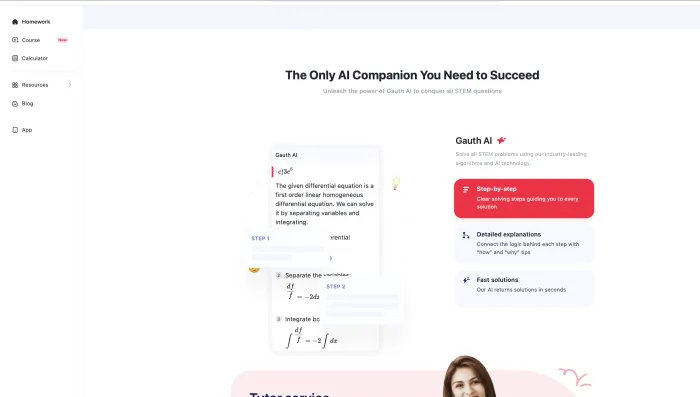
The efficiency of that loop is real and is the single biggest reason the tool has the user base it does. The questions worth asking are how often the solution is correct, what the loop costs, and what happens when a student tries to stop paying for it.
How Accurate Is Gauth AI?
Accuracy is not uniform, and treating it as a single number is where most reviews go wrong. Performance separates cleanly into three bands.
Where it performs well
Standard secondary-school mathematics with clean input is handled reliably. Independent testing against SAT-level algebra questions has produced correct answers with sound step-by-step reasoning, including on multi-part questions requiring conditional evaluation. Handwriting recognition performs well enough that notebook problems and whiteboard photographs are usable inputs.
Published testing has also found that the system asks for clarification on deliberately underspecified questions, such as a travel time problem with no speed given, rather than hallucinating a value. That behaviour is a meaningful quality indicator and is not universal across AI tools.
Humanities and social science questions are handled competently at school level, with reasonable literary analysis and accurate factual recall on standard curriculum topics.
Where it degrades
Accuracy falls as problem complexity rises. Advanced calculus, multi-step proofs, and university-level work produce a materially higher error rate. User reports include solutions that contradict themselves internally and, in the most striking category, responses drawn from the wrong subject entirely, such as mathematical working returned for a history question.
Poor input quality compounds this. A blurred photograph, an angled capture, or dense handwriting can cause the OCR layer to misread a term, after which the solution is confidently and completely wrong with no indication that the input was misinterpreted.
The correction problem
This is the most useful finding in the user data and it appears nowhere in the currently ranking reviews.
Multiple users independently report that when the model produces a wrong answer, it will not revise it. Telling it the answer is incorrect produces the same answer restated in slightly different wording rather than a genuine reconsideration. Users describe a specific workaround: abandoning the session entirely, retaking the photograph, and cropping out the answer option the model kept selecting, which forces a fresh evaluation.
The practical conclusion is that Gauth AI functions as a first-pass assistant requiring independent verification, not as an authority. That is a substantially different proposition from how the category markets itself, and it changes what the tool is worth. A homework helper that requires checking is still useful for learning. It is not useful for producing answers under time pressure, which is what most users appear to want from it.
Why the Gauth AI Ratings Are So Polarised
Published ratings for Gauth AI split violently, and the reason turns out to be identifiable rather than random.
A distinct cluster of enthusiastic reviews reference one specific use case: Sparx Maths, a homework platform widely used in UK schools. Users describe completing Sparx assignments in twenty minutes and call the tool essential for that purpose. One review states the reason plainly, observing that the tool has access to the majority of Sparx questions, which effectively guarantees correct answers.
That single observation reconciles the entire rating distribution.
| Task type | What the tool is doing | Reliability |
|---|---|---|
| Known question banks | Problems that are widely used, publicly circulated, and repeatedly encountered | Approaches retrieval rather than reasoning, answers near-certain |
| Novel problems | Original teacher-written questions, exam papers, unusual phrasings | Depends on genuine reasoning, error rate rises sharply |
Positive reviews cluster heavily in the first category. The most damaging negative reviews, describing failed tests and zero scores, cluster in the second. Both groups are reporting accurately about different tasks.
Gauth AI Free Tier: What Is Actually Included
The free tier exists and is functional, but it is more constrained than the marketing implies, and the constraints differ by device in a way that catches users out.
| Feature | Gauth Free | Gauth Plus |
|---|---|---|
| Daily question limit | Capped, with reports ranging from a handful to around 11 per day | Unlimited |
| Solution detail | Basic answers, fuller step breakdowns often gated | Full step-by-step |
| Assignment solver credits | None | Included monthly allocation |
| Human tutor access | Not included | 24/7 access |
| Ads | Yes | No |
| Peak-time speed | May slow | Priority |
| Video library | Limited | Full access |
Three things about the free tier appear consistently in user reports and are absent from published reviews.
- The browser version is more restricted than the app. Multiple users report being cut off after roughly three questions on desktop while the mobile app allowed considerably more, and describe repeated prompting to download the app to continue. Anyone evaluating the tool in a browser and concluding it is unusable may be assessing a deliberately weaker tier.
- Limits are reported as persisting between sessions. Some users describe encountering a quota-exhausted message after days or weeks of not using the tool at all, suggesting either a bug or an accounting method that is not clearly communicated.
- Gating tightened over time. A recurring theme among long-term users is that earlier versions offered broader free access and that functionality once available without payment now sits behind the subscription.
Gauth Plus Pricing
| Term | Total price | Effective monthly |
|---|---|---|
| Monthly | $11.99 | $11.99 |
| Quarterly | $31.99 | About $10.66 |
| Annual | Up to $99.99 | About $8.33 |
A three-day trial is offered, and payment details are required upfront to begin it.
Measured against private tutoring, which commonly runs upward of $40 per hour in the US, the annual rate is defensible for a student using the tool several times a week. Measured against general-purpose AI assistants with study modes at comparable or lower cost, the case is narrower and rests mainly on the bundled human tutor access.
The price inconsistency reports
Published pricing is not what several users describe encountering, and this is worth flagging because no other review covers it.
One detailed report documents reinstalling the app on consecutive days and being shown a three-day trial followed by $31.99 on the first day and $41.99 on the second, for what appeared to be the same offer. Other reported charges across the review set include $34.11, $49.99 for a six-month term, $99.99 billed annually, and amounts of £24.99, £30, and £50 in sterling.
Some variance is expected from regional pricing, currency conversion, and promotional testing, all of which the operator acknowledges by noting that in-app prices may differ. The volume and spread of the reported figures nonetheless mean that the published price should be treated as indicative rather than fixed.
Billing and Cancellation: The Dominant Complaint
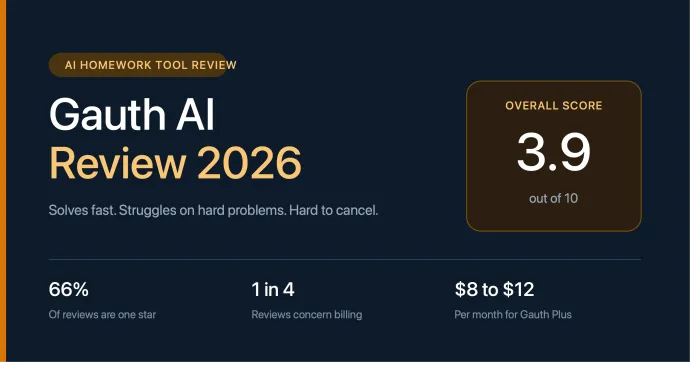
Approximately one quarter of all 79 reviews analysed concern billing, and roughly 38 percent of the one-star reviews are billing complaints specifically. No review currently ranking for this term covers this at proportionate weight, and the most authoritative one awards a high rating without testing cancellation at all.
The reported patterns are specific and repeat across independent reviewers.
- Charges landing during the free trial rather than after it. Multiple users describe a pending charge appearing within minutes of starting a three-day trial, in one case within ten minutes of signup.
- Cancellation flows that do not complete. Users describe attempting cancellation in-app and on the website and receiving a network exception error, and describe being routed in circles between the app store and the developer with neither accepting responsibility.
- Login failing at the point of cancellation. Several users report that attempting to sign in to cancel returns a message that the email address is not registered, using the same address the subscription confirmation was sent to.
- Charges continuing after confirmed cancellation. Multiple users report a charge landing hours or days after cancelling, and one reports an attempted charge after unsubscribing within the trial window.
- Long-running accumulation. One user reports being billed monthly for more than two years while repeatedly attempting to cancel, totalling over $320. Another describes six months of attempts and roughly $100 lost. A third describes an unresolved dispute running since 2023 with intermittent charges requiring ongoing account monitoring.
- Refund requests declined without stated reason. One detailed account describes two app store refund requests denied with identical boilerplate and no explanation, on an account with two questions of usage.
- Automatic enrolment into longer terms. One user reports being enrolled in an annual plan at $99.99, being asked to prove the transaction occurred, supplying a screenshot, and then receiving no further response.
Support non-response is cited in the large majority of these accounts. The pattern is consistent: emails unanswered across weeks, no telephone contact available, and app store escalation producing no resolution. In most of these cases the user's stated final step is a bank chargeback, which is what people do when a cancellation process has failed rather than when a product has merely disappointed.
What 79 User Reviews Show
A full read of 79 published user reviews produces a distribution that the headline average conceals entirely.
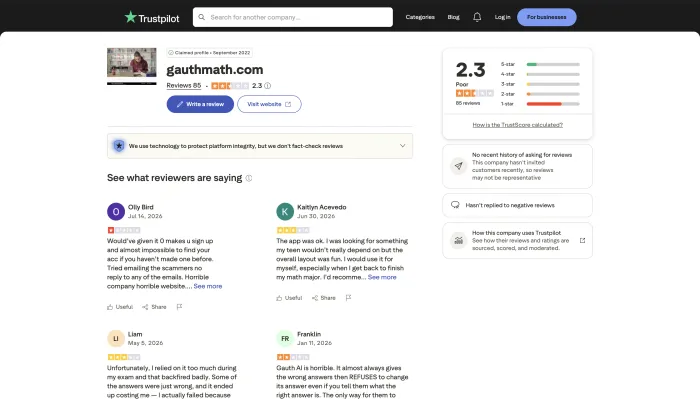
| Rating | Count | Share of reviews |
|---|---|---|
| 5 star | 16 | 20% |
| 4 star | 2 | 3% |
| 3 star | 4 | 5% |
| 2 star | 5 | 6% |
| 1 star | 52 | 66% |
The mean lands near 2.1 out of 5, but almost no reviewer actually holds a middling opinion. This is not a product people find adequate. It is a product that either works for them or costs them money and marks.
Accuracy complaints, and what they have in common
The second-largest complaint cluster concerns wrong answers, and the reports are more specific than generic dissatisfaction:
- Answers described as internally contradictory rather than simply incorrect
- The model restating a rejected answer rather than reconsidering it
- Solutions returned from an unrelated subject
- Errors in basic operations including multiplication and parenthesis handling
- Explanations described as more confusing than the original problem
Several reviewers report concrete academic consequences, including failed tests and zero scores after relying on the tool for revision or during assessment. One reviewer describes two students using the same tool on the same test and receiving markedly different results, which points toward non-determinism in the output rather than uniform reliability.
What satisfied users describe
- Speed and convenience of the photograph-to-solution loop
- Step-by-step explanation quality, particularly the ability to ask a follow-up and receive elaboration rather than repetition
- Availability when human help is not, with several users noting it fills the gap when parents cannot help with the material
- Sparx Maths and similar platform homework, by far the most frequently named specific use case
- Confidence and stress reduction, with several users describing reduced anxiety around homework independently of grade outcomes
Notably, almost none of the positive reviews describe using the tool successfully under examination conditions or on advanced material. The praise is concentrated in exactly the band where the accuracy analysis predicts it should be.
All user sentiment above is summarised and paraphrased from published reviews rather than quoted, and represents recurring themes rather than isolated claims. Individual accounts are not independently verifiable and should be read as claims. The value sits in the pattern and the pattern is consistent.
Why Gauth AI May Not Be Working
| Symptom | Likely cause | What resolves it |
|---|---|---|
| Question limit reached without recent use | Quota accounting or a known bug | Wait for reset, or check the account is signed in correctly |
| Far fewer free questions on a laptop than a phone | The browser tier is more restricted than the app | Use the mobile app for the fuller free allocation |
| Repeated prompts to download the app | Feature gating on the web version | Expected behaviour rather than a fault |
| Answer refuses to change when corrected | Response anchoring within the session | Start a new session and recapture with the rejected option cropped out |
| Wrong answer on a clearly legible problem | OCR misreading a term or exponent | Recapture straight-on with good lighting, or type the problem manually |
| Solution from an unrelated subject | Problem type misclassification | Recapture with only the target question in frame |
| Login rejected as unregistered | Account and email mismatch | Check for a second account created via a different sign-in method |
| Answers submitted successfully but marked wrong | The verification gap described above | Independent checking before submission |
Academic Risk and School Policy
Institutional policy on AI homework assistance ranges from permitted with disclosure through to prohibited outright, and the same tool can be an approved study aid in one classroom and an academic integrity violation in the next. Detection does not depend solely on software. A student who submits correct work and cannot explain the method under questioning is identified without any detector being involved, and the resulting consequence is typically more serious than a poor grade.
The dependency risk is separate and more insidious. A tool that produces a correct answer in seconds removes the productive difficulty that homework exists to create. Several long-term users describe exactly this outcome, reporting a stronger homework record alongside no improvement in assessment performance.
Gauth AI Alternatives
| Tool | Strongest at | Main limitation | Best suited to |
|---|---|---|---|
| Photomath | Clear step explanations for school math | Weaker on word problems and advanced topics | Middle and high school math |
| Symbolab | Wide coverage through university calculus | Full steps behind a paywall, steeper interface | Advanced math and symbolic work |
| Mathway | Breadth across math, statistics, and science | Explanation depth varies, steps are paid | Multi-subject STEM workloads |
| Socratic | Multi-subject school coverage, free | Limited on advanced math, briefer solutions | Younger students across subjects |
| Wolfram Alpha | Computational power and accuracy | Explains less, teaches less | Verification and heavy computation |
| General AI assistants | Conceptual explanation and dialogue | Requires competent prompting, weaker math formatting | Understanding concepts rather than computing |
| Chegg | Human tutoring and textbook solutions | Considerably more expensive | College coursework needing real depth |
Best for verification: Wolfram Alpha
It computes rather than predicts, which addresses the verification gap directly and costs nothing for most queries.
Best for school-level steps: Photomath
Consistently clearer instructional breakdowns for algebra, geometry, and basic calculus.
Best for advanced math: Symbolab
Symbolic manipulation and detailed derivations that hold up at university level.
Lowest billing risk
Tools billed through an app store account can be cancelled through the platform rather than the developer, removing the most reported failure point in this review.
Gauth AI Pros and Cons
What Works
- The photograph-to-solution workflow is fast and genuinely convenient.
- OCR handles handwriting and mathematical notation well.
- Step-by-step explanations are often clearer than textbook equivalents.
- Follow-up questioning produces elaboration rather than repetition.
- Broad subject coverage extending well beyond mathematics.
- Reliable on standard school-level problems with clean input.
- Asks for clarification on underspecified questions rather than inventing values.
- Human tutor access included at a fraction of private tutoring cost.
- Available across web, iOS, Android, Windows, and browser extension.
What Does Not
- Billing complaints account for roughly a quarter of all published user reviews.
- Cancellation flows are widely reported to fail, with errors and login rejections at the point of cancelling.
- Charges are reported landing during the free trial rather than after it.
- Reported prices vary between sessions for what appears to be the same offer.
- Support non-response is reported in the large majority of billing complaints.
- Accuracy degrades sharply on advanced material.
- The model resists correction and restates rather than reconsiders.
- No reliable uncertainty signal, so wrong answers arrive with the same confidence as right ones.
- Documented cases of failed tests and zero scores following reliance on the tool.
- Browser version materially more restricted than the mobile app without clear disclosure.
- Free tier gating has tightened over time relative to earlier versions.
- Two thirds of published user reviews are the lowest possible rating.
Who should use it
- Students working through standard school-level homework who verify results independently.
- Learners who struggle with textbook explanations and benefit from labelled steps.
- Students who have already attempted a problem and want to locate where their method broke.
- Households prepared to manage the subscription actively and monitor the payment method.
- Users on a platform where the subscription can be cancelled through the app store account.
Who should look elsewhere
- Students working above undergraduate level, where the error rate is highest.
- Anyone submitting answers without independent verification.
- Students in institutions with strict AI policies, where the academic risk exceeds the benefit.
- Anyone unwilling to monitor a recurring charge or pursue a chargeback if required.
- Younger students without adult oversight of the payment method.
- Anyone whose main need is verification rather than explanation.
Using Gauth AI Safely
On accuracy
Photograph problems straight on, in good light, with only the target question in frame. Type the problem manually where handwriting is dense or notation is complex. Verify any answer that matters against a computational tool or a second source. Treat consistency across two independent tools as the confidence threshold, not confidence from one. If the model produces an answer that seems wrong, start a new session rather than arguing with it.
On subscriptions
For parents
Any subscription taken by a school-age student should sit on a payment method with a visible transaction feed and, ideally, a spending cap. Where the household has app store family controls, routing the purchase through them puts cancellation inside the parent's account rather than the developer's flow. It is worth establishing with the student that the tool is used after attempting work rather than instead of it, since the academic risk described above lands on the student rather than the payer.
Scoring Methodology: The Study Tool Accountability Framework
This review was assessed under the Study Tool Accountability Framework (STAF), a weighted six-factor model built for AI study tools. Billing integrity carries equal weight to answer accuracy, on the reasoning that a study tool which cannot be cancelled has failed the user just as concretely as one which returns wrong answers, and that this dimension is systematically under-weighted in published reviews of the category.
| Factor | Weight | Score | Basis |
|---|---|---|---|
| Answer accuracy | 25% | 5.5 / 10 | Strong on standard school math with clean input, degrades sharply on advanced material, no reliable uncertainty signal |
| Billing and cancellation integrity | 25% | 2.0 / 10 | Billing complaints in approximately a quarter of all reviews, failed cancellation flows, charges during trial, reported price variance |
| Learning value | 15% | 5.0 / 10 | Genuinely good step explanations offset by an answer-first design and documented dependency outcomes |
| Free tier usability | 15% | 3.5 / 10 | Functional but tightly capped, ad-supported, undisclosed disparity between browser and app |
| Support responsiveness | 10% | 2.5 / 10 | Non-response reported in the large majority of billing complaints, no telephone route |
| Platform consistency | 10% | 4.5 / 10 | Broad platform coverage undermined by feature disparity and reported instability |
| Weighted overall | 3.9 / 10 | Approximately 2.0 out of 5 stars |
Scoring draws on the operator's published pricing and feature documentation, independently published hands-on accuracy testing, and a full read of 79 published user reviews. No figure is estimated where a documented source exists, and reported ranges are presented as ranges rather than averaged into false precision. Where user claims could not be independently verified, they are described as reports rather than facts, and weight is placed on the frequency and consistency of a pattern rather than any single account.
Final Verdict: Is Gauth AI Worth It in 2026?
Gauth AI is a competent solving engine wrapped in a subscription layer that a large share of its users describe as difficult to escape.
The product itself is not bad. Photograph a standard algebra problem and the answer arrives in seconds with steps that are frequently clearer than the textbook. The OCR is good, the follow-up questioning works, and for a student who has hit a wall at eleven at night with nobody to ask, that is a real service. The enthusiastic reviews are not fabricated. They are describing something that genuinely happens.
But two structural problems sit underneath it. The first is that the tool is least reliable exactly where it is trusted most. It performs near-perfectly on widely circulated question banks, which is where most students first calibrate their confidence, and considerably worse on novel problems, which is where tests live. Because it does not signal uncertainty and resists correction, a student has no way to tell which mode they are in. The reviews describing failed tests and zero scores are the predictable consequence of that gap, not user error.
The second is the billing layer, and it is the reason this review scores the tool far below the published consensus. When a quarter of all user reviews concern charges, when cancellation flows return errors, when login fails at the moment of cancelling, when charges land during a trial and after cancellation, and when support does not answer, the resulting pattern is not a series of unrelated support failures. It is a system that works better in one direction than the other. That a fifteen-year-old is among the accounts describing it makes the point sharper rather than softer.
The recommendation: the free tier is worth trying for a student who verifies answers independently and treats the tool as a way to check reasoning rather than obtain results. Before any paid subscription is started, locate the cancellation route and, where possible, route the purchase through an app store account so that cancelling does not depend on the developer's own flow. Screenshot the price at the point of purchase. And any student relying on it for assessment preparation should verify against a computational engine, because the tool's confidence is not correlated with its accuracy.
Gauth AI FAQs
Gauth AI, formerly Gauthmath, is a homework assistance app operated by ByteDance. It reads a photographed or typed problem through optical character recognition and returns a worked solution with step-by-step explanations across math, science, and several humanities subjects.
There is a free tier, but it is capped at a limited number of questions per day and is ad-supported. The browser version is materially more restricted than the mobile app, with users reporting being cut off after around three questions on desktop while the app allowed considerably more.
Accuracy varies by task. Standard school-level math with clean input is handled reliably, and independent testing has produced correct answers on SAT-level algebra. Accuracy falls sharply on advanced calculus, multi-step proofs, and university-level work, and the tool gives no reliable signal about which case applies.
Users report that correcting the model within a session produces the same answer restated rather than a genuine reconsideration. The workaround users describe is starting a new session and recapturing the image with the rejected answer option cropped out, which forces a fresh evaluation.
Published pricing is $11.99 monthly, $31.99 quarterly, and up to $99.99 annually, which works out to about $8.33 per month on the annual term. Users report encountering different amounts for what appears to be the same offer, so the price should be confirmed on the payment screen before authorising.
Where the subscription was purchased through an app store, cancelling through the platform account is the more reliable route, since it does not depend on the developer's own cancellation flow. Users widely report the in-app and website flows failing with errors or rejecting a login at the point of cancelling. Verify the cancellation on the statement rather than assuming it took effect.
It is a real product from an identifiable operator that delivers the solving functionality it advertises, so it is not a scam in the sense of taking money for nothing. The volume of reports about charges landing during a trial, cancellation flows failing, and support not responding is nonetheless substantial enough that the payment side warrants active management.
Yes, through a combination of AI detection tools and direct questioning. A student who submits correct work but cannot explain the method is identified without any detector involved, and the consequence under most academic integrity policies is more serious than a poor grade.
The most common causes are the daily question cap being reached, the browser version being more restricted than the app, OCR misreading a poorly captured image, and account or login mismatches where a second account was created through a different sign-in method.
It depends on the need. Photomath gives clearer step explanations for school-level math, Symbolab handles advanced and symbolic work, Socratic covers multiple subjects for free, and Wolfram Alpha is the strongest option for verifying an answer because it computes rather than predicts.