Is ChatGPT Free? Free vs Plus Plans Compared (2026)
Written by Sanya Goyal
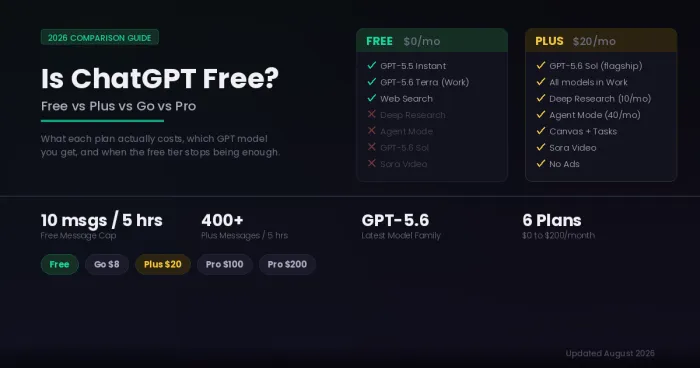
Over 900 million people use ChatGPT every week, and the majority of them never pay a cent. OpenAI's free tier has quietly become one of the most capable AI products available at zero cost, running GPT-5.5 Instant in standard chat and, since July 2026, GPT-5.6 Terra inside ChatGPT Work and Codex. But the gap between free and paid widens the moment a user needs deep research, autonomous agents, or the flagship GPT-5.6 Sol model. This guide breaks down exactly what ChatGPT's free plan includes as of August 2026, how it compares to Plus and every other tier, and when upgrading becomes a practical necessity rather than a luxury.
What ChatGPT's Free Plan Includes in August 2026
ChatGPT is free. Anyone can create an account at chatgpt.com, download the iOS or Android app, and start chatting without entering a credit card. The free plan is permanent, not a trial.
Here is what free users get today:
GPT-5.5 Instant is the default model in standard chat. It handles everyday questions, writing, summarization, and brainstorming well. The catch is a rolling cap of roughly 10 messages every five hours. After hitting that ceiling, ChatGPT falls back to a lighter mini model until the window resets. The quality difference on complex prompts is noticeable.
GPT-5.6 Terra in ChatGPT Work and Codex is the part most guides miss. Since the GPT-5.6 launch on July 9, 2026, free users can access Terra (the balanced mid-tier model that rivals the previous generation's flagship) inside ChatGPT Work and the Codex coding interface. Terra cannot be selected in a regular chat window, but it runs behind the scenes when free users open Work or Codex.
Beyond model access, free users also get web search for real-time information, limited image generation (roughly five images per day via GPT Image), file uploads capped at three per day, browsable access to the GPT Store (pre-built custom GPTs for specific tasks), memory across sessions (limited compared to paid tiers), standard voice mode powered by GPT-Live-1 mini, chat history that persists across sessions, and a 16K non-reasoning context window.
What the free plan excludes is equally important. Deep Research, Agent Mode, Canvas, Tasks, Sora video generation, Advanced Voice with video and screen sharing, custom GPT creation, and the flagship GPT-5.6 Sol model are all reserved for Plus ($20/month) or higher.
One more thing: since February 9, 2026, free users in the United States see sponsored results at the bottom of some responses. The ads are labeled and separated from the actual answer, but they are there.
Free Without an Account vs Free With Login
OpenAI actually offers two free experiences, and the difference matters.
No-login access lets anyone visit chatgpt.com and start prompting without creating an account. It sounds generous, but the tradeoffs are steep. Every session evaporates when the tab closes (no conversation history). File and image uploads are unavailable. Voice mode, the GPT Store, memory, ChatGPT Work, and Codex are all locked. The message cap is even stricter. This version exists as a proof of concept, not a productivity tool.
Free with a login changes the experience significantly. Signing up with Google, Apple, or email unlocks persistent chat history, memory across sessions, file uploads (three per day), image generation, GPT Store browsing, voice mode, and access to ChatGPT Work and Codex with GPT-5.6 Terra. The model access and message limits stay the same, but the ability to pick up where you left off transforms ChatGPT from a disposable demo into something genuinely useful for daily tasks.
For anyone planning to use ChatGPT more than once, creating a free account is the obvious first step.
ChatGPT Free vs Plus: Complete Feature Comparison
The $20/month Plus plan is where OpenAI draws its sharpest line. Here is how it compares to Free across every major feature category.
AI Models and Intelligence Tier
Free users get GPT-5.5 Instant in standard chat and GPT-5.6 Terra in Work and Codex. Plus users get GPT-5.6 Sol (the flagship model that outperforms every previous OpenAI release across coding, reasoning, and knowledge work) selectable through reasoning effort settings, with GPT-5.5 Instant still available as the fast default. Plus also unlocks all three GPT-5.6 models (Sol, Terra, Luna) in ChatGPT Work and Codex, along with legacy models for users who need them.
The practical difference shows up in complex tasks. Sol supports a 1,050,000-token context window and 128K max output, can run in "max" mode for deeper reasoning, and offers "ultra" mode that coordinates multiple parallel AI agents on a single task. Terra is capable, but Sol operates at a different level of precision and depth.
Message Limits and Rate Caps
Free users get approximately 10 GPT-5.5 Instant messages every five hours. After that, the system switches to a mini model. Plus users get significantly higher limits (OpenAI has stated 400 to 2,000 messages per five-hour window for GPT-5.5 Instant, though exact numbers fluctuate). Plus also includes GPT-5.5 Thinking messages (3,000 per week) for advanced reasoning tasks.
For casual users who send a handful of questions per day, the free cap rarely bites. For anyone using ChatGPT as a work tool, the 10-message ceiling creates friction within a single focused session.
Deep Research
Deep Research lets ChatGPT crawl the web in real time, synthesize dozens of sources, and deliver a cited report. Free users have no access to this feature. Plus users get 10 Deep Research sessions per month, each of which can run for five to 30 minutes and process large volumes of information.
For students writing research papers, analysts comparing market data, or journalists fact-checking claims, Deep Research alone can justify the $20 subscription.
Agent Mode and ChatGPT Work
Agent Mode lets ChatGPT take multi-step actions autonomously: browsing websites, running code, filling out forms, and connecting to third-party services. Free users cannot access Agent Mode. Plus users get 40 Agent Mode messages per month.
ChatGPT Work is a newer, broader concept. It is an agent workspace that can use local files, connected apps (Slack, Google Drive, GitHub), and a built-in browser to complete complex tasks like building presentations, analyzing spreadsheets, and generating reports. Free and Go users access ChatGPT Work powered by GPT-5.6 Terra. Plus users get Sol, Terra, and Luna as options. Work initially launched for Pro and Enterprise on July 9, 2026, and expanded to Plus and Business shortly after.
This is the one area where free users actually touch the GPT-5.6 family, so it is worth exploring even without a paid plan.
Codex and Coding Tools
Codex is OpenAI's specialized software engineering agent. It can analyze code, write new functions, fix bugs, and turn natural language instructions into working code across Python, JavaScript, Go, and other languages. The Codex coding interface is available to free users (with GPT-5.6 Terra), and Codex Mobile launched free on every tier on May 14, 2026.
However, cloud-based Codex tasks, higher usage limits, and Sol-powered Codex sessions require Plus or higher. Free users can do lightweight coding work; heavy development workflows will hit the cap quickly.
Image and Video Generation
Free users can generate images using GPT Image, capped at roughly five per day. Plus users get higher quotas and access to ChatGPT Images 2.0 with the Thinking Mode toggle for more refined outputs.
For video, Sora (OpenAI's video generation tool) is Plus-only. Free users cannot generate video content through ChatGPT.
Canvas, Tasks, and Projects
Canvas is a collaborative workspace for writing and coding projects that provides a side-by-side editing view. Tasks allows ChatGPT to run scheduled prompts and send notifications automatically (up to 10 active tasks). Both are Plus-only features.
Projects, which let users organize chats, files, and instructions in one workspace, are available on both free and paid plans. Free users can create projects but are limited to three file uploads per day, compared to 25 files per project and 10 simultaneous uploads on Plus.
Voice Mode
Both plans support voice interaction. Free users get standard voice powered by GPT-Live-1 mini with a daily usage cap. Plus users get Advanced Voice with substantially better audio quality, near-unlimited usage, and the ability to share video, photos, or a screen for real-time visual feedback during voice conversations.
Memory and Context Window
Free users have limited memory across sessions and a 16K non-reasoning context window (roughly 20 pages of text). Plus users get extended memory and a 32K non-reasoning context, with Sol supporting over 1 million tokens for reasoning tasks (roughly 1,300 pages).
For short conversations, the free memory is fine. For ongoing projects where ChatGPT needs to reference earlier work, the paid tier's expanded memory and context window make a tangible difference.
Ads
Free and Go users in the United States see sponsored results at the bottom of some ChatGPT responses, labeled and separated from the answer. Plus and all higher tiers are completely ad-free.
Full Comparison Table: ChatGPT Free vs Plus
| Feature | ChatGPT Free ($0) | ChatGPT Plus ($20/month) |
|---|---|---|
| Standard chat model | GPT-5.5 Instant | GPT-5.5 Instant (default), GPT-5.6 Sol (reasoning) |
| Work and Codex model | GPT-5.6 Terra | GPT-5.6 Sol, Terra, Luna (selectable) |
| Message cap (standard chat) | ~10 per 5 hours, then mini fallback | 400-2,000+ per 5 hours |
| Context window | 16K (non-reasoning) | 32K (non-reasoning), 1M+ (Sol reasoning) |
| Deep Research | Not available | 10 sessions per month |
| Agent Mode | Not available | 40 messages per month |
| ChatGPT Work | Available (Terra) | Available (Sol, Terra, Luna) |
| Codex / Codex Mobile | Available (Terra, limited) | Available (Sol, higher limits) |
| Canvas | Not available | Available |
| Tasks | Not available | Available (10 active) |
| Projects | Available (limited uploads) | Available (25 files per project) |
| Image generation | ~5 per day | Higher quota, Images 2.0 Thinking Mode |
| Sora video generation | Not available | Available |
| Voice mode | Standard (GPT-Live-1 mini) | Advanced Voice with video/screen sharing |
| Custom GPT creation | Not available | Available |
| GPT Store access | Browse and use | Full access |
| Memory | Limited | Extended |
| File uploads | 3 per day | 80 per 3 hours |
| Ads (US) | Yes (since Feb 2026) | No |
| Priority during peak hours | No | Yes |
All ChatGPT Plans at a Glance
OpenAI currently offers six consumer tiers and an API. Here is the full pricing ladder:
Free ($0/month): GPT-5.5 Instant with tight caps, GPT-5.6 Terra in Work/Codex, ads in the US, and no access to Deep Research, Agent Mode, Canvas, Tasks, or Sora. Best for casual, occasional use.
Go ($8/month): Same GPT-5.5 Instant model as Free but with significantly higher message limits. GPT-5.6 Terra in Work/Codex. Still shows ads. Still excludes Deep Research, Agent Mode, Canvas, Tasks, and Sora. Best for users who only need more messages and do not require advanced features.
Plus ($20/month): The tier that unlocks the full feature set. GPT-5.6 Sol, Deep Research (10/month), Agent Mode (40/month), Canvas, Tasks, Sora, Advanced Voice, Custom GPT creation, and no ads. The price has held at $20 for three years. Best for daily professional use.
Pro ($100/month): Everything in Plus with 5x the usage limits, GPT-5.5 Pro model access, and a 1M-token context window. Best for heavy users who regularly hit Plus caps.
Pro ($200/month): Everything in Pro $100 with 20x Plus usage limits and priority access to new features. Best for researchers, developers, and power users running parallel workloads.
Business ($20-25/seat/month): Team-oriented plan with admin controls, ISO 27001 compliance, and shared workspaces. Minimum two seats.
Enterprise (custom pricing): Unlimited access, enterprise-grade security, SSO, and custom deployment options.
Who Should Stay on the Free Plan
The free plan is a legitimate product, not a teaser. These users will rarely need to upgrade:
Occasional question-askers. People who use ChatGPT a few times per week for quick answers, definitions, or brainstorming will rarely hit the 10-message ceiling within a single five-hour window.
Students doing light homework help. For understanding concepts, getting explanations of difficult material, or generating study questions, the free tier covers the core use case. The GPT-5.5 Instant model handles educational content well.
Explorers and first-time users. Anyone evaluating whether AI chatbots fit into their workflow should start free. The limits become obvious quickly, and that is useful information before committing money.
Developers testing ideas. Between Codex Mobile (free on all tiers) and GPT-5.6 Terra in the Codex interface, free users can handle lightweight coding tasks, quick debugging, and prototype generation.
When Upgrading to Plus Makes Sense
The upgrade decision is not philosophical. It comes down to friction: how often do the limits interrupt something that matters? Consider Plus if any of these apply:
The 10-message cap interrupts your work sessions. If a single focused task (drafting an email sequence, analyzing a document, working through a coding problem) burns through 10 messages before it is finished, Plus removes that bottleneck.
Deep Research would save you real time. Anyone regularly compiling information from multiple sources (students writing research papers, marketers analyzing competitors, journalists fact-checking stories) will recoup the $20 in time savings from even two or three Deep Research sessions per month.
You need Agent Mode for multi-step automation. Searching flights, filling out forms, connecting to external services, and executing complex workflows require Agent Mode, which is Plus-only.
Peak-hour slowdowns cost you productivity. Free users go to the back of the queue during high-traffic periods. Plus guarantees faster response times and uninterrupted access to the primary model.
You want to create custom GPTs. Building a GPT tailored to a specific workflow (a brand voice editor, a meeting summarizer, a code reviewer with custom instructions) requires a paid subscription.
How to Get the Most Out of ChatGPT Free
The free tier has real constraints, but strategic use can stretch those constraints further than most people realize.
Use ChatGPT Work for complex tasks. Since Work runs on GPT-5.6 Terra (a stronger model than the GPT-5.5 Instant in standard chat), routing complex requests through Work gives free users access to better intelligence at zero cost. Open the ChatGPT desktop app or navigate to the Work interface to take advantage of this.
Batch your questions. Instead of sending 10 separate one-line messages, combine related questions into a single, detailed prompt. A well-structured prompt that covers three questions in one message uses one message slot instead of three.
Set custom instructions once. Free users can set persistent custom instructions (tone preferences, output format, professional context) under Settings. This prevents wasting messages on repeated setup instructions at the start of every conversation.
Save your high-value prompts for GPT-5.5. If you know a task is simple (basic definitions, quick rewording), wait until the mini fallback model is active and use it for easy questions. Save your 10 premium messages for tasks that genuinely benefit from the stronger model.
Leverage Codex Mobile for coding. Codex Mobile launched free on May 14, 2026, and works on every tier. For quick code generation, bug fixes, and code explanations on the go, this is a zero-cost tool that many free users overlook.
Explore the GPT Store. Thousands of pre-built custom GPTs exist for specific tasks: writing, research, SEO analysis, translation, image prompting, and more. Free users can browse and use all of them. The only restriction is creating new ones.
Free Alternatives Worth Considering
Users searching for "is ChatGPT free" are often price-sensitive. Several other AI chatbots offer competitive free tiers:
Google Gemini provides free access to the Gemini model with tight integration into Google Workspace (Docs, Sheets, Gmail). The free tier has generous usage limits and supports image generation, making it a strong option for Google-ecosystem users.
Claude by Anthropic offers a free tier with access to the Claude Sonnet model. Claude is widely regarded as stronger than ChatGPT for long-form writing, document analysis, and nuanced reasoning, though its free tier also has message caps.
Microsoft Copilot is free and integrated into the Edge browser, Windows, and Microsoft 365. It runs on OpenAI models and offers web-grounded answers with citations, making it a solid alternative for users already in the Microsoft ecosystem.
Perplexity AI focuses specifically on research and web search. Its free tier delivers cited, source-linked answers and works well as a research companion alongside ChatGPT.
None of these are direct replacements. Each excels in a different niche. Many power users combine a free ChatGPT account with one or two of these alternatives to avoid hitting any single platform's limits.
Verdict
ChatGPT is free, and the free plan is genuinely useful for millions of people. It runs a capable model (GPT-5.5 Instant), supports web search, image generation, voice, memory, file uploads, and GPT Store access, and since July 2026, even gives free users a taste of the GPT-5.6 generation through ChatGPT Work and Codex.
The honest boundary is this: the free tier handles casual, light, and occasional use well. The moment ChatGPT becomes a daily work tool (for writing, research, coding, or automation), the 10-message cap, missing Deep Research, absent Agent Mode, and lack of the flagship Sol model create real friction. Plus at $20/month removes all of those barriers at a price that has not changed in three years.
Start free. Use it until the limits interrupt your work. When they do, you will already know exactly which paid features are worth paying for.
FAQ
Is ChatGPT completely free to use?
Yes. ChatGPT has a permanent free plan at chatgpt.com and on the iOS and Android apps. No credit card is required. Free users get GPT-5.5 Instant with a cap of roughly 10 messages every five hours, plus GPT-5.6 Terra inside ChatGPT Work and Codex. Features like Deep Research, Agent Mode, and Sora require a paid plan starting at $20/month.
What is the difference between ChatGPT Free and ChatGPT Plus?
Plus ($20/month) removes ads, upgrades the default reasoning model to GPT-5.6 Sol, raises message limits to 400 or more per five hours, and unlocks Deep Research (10 sessions/month), Agent Mode (40 messages/month), Canvas, Tasks, Sora video generation, Advanced Voice with screen sharing, and custom GPT creation. Free users retain access to GPT-5.5 Instant, basic voice, web search, and limited file/image capabilities.
Is ChatGPT Go worth it compared to the free plan?
Go costs $8/month and gives significantly more GPT-5.5 Instant messages than Free, but it still shows ads and excludes Deep Research, Agent Mode, Canvas, Tasks, and Sora. It makes sense only for users whose sole frustration is the 10-message cap. If you need advanced features, Plus at $20/month is the better upgrade.
Can I use ChatGPT without creating an account?
Yes. Visiting chatgpt.com lets you prompt without logging in, but the experience is heavily restricted: no chat history, no file uploads, no voice, no memory, and no access to ChatGPT Work or Codex. Creating a free account unlocks all of these at no cost.
Does ChatGPT Free show ads?
Yes, in the United States. Since February 9, 2026, free and Go users see sponsored results at the bottom of some responses. The ads are labeled and separated from the answer. Plus ($20/month) and all higher tiers are ad-free.
What model does ChatGPT Free use?
In standard chat, the free plan runs GPT-5.5 Instant (as of May 5, 2026). After hitting the message cap, it falls back to a lighter mini model. Inside ChatGPT Work and Codex, free users get GPT-5.6 Terra, which performs at a level comparable to the previous generation's flagship.
Is ChatGPT Plus worth $20 a month?
For users who rely on ChatGPT daily for work, the answer is generally yes. Plus provides the flagship GPT-5.6 Sol model, Deep Research, Agent Mode, Canvas, and significantly higher usage limits. The $20 price has remained unchanged for three years, and a single Deep Research session that replaces hours of manual research can recoup the subscription cost in saved time.