Grizzly SMS Review: Is It Legit, Safe & Worth It? (2026)
Written by Viraj Pandit
Grizzly SMS is a virtual phone number service that lets you receive SMS verification codes without using your real number. It's inexpensive, it works for what it's designed to do, and it's genuinely useful in a narrow set of situations — while being actively risky in the situations most people actually want it for. This review covers what it is, what it really costs, whether it's safe, where it's legitimately useful, and the account-ban risk that no promotional review will tell you about.
Quick Verdict
Grizzly SMS is a real, functioning service — not a scam. It provides temporary and rentable virtual numbers across many countries, charges per successful SMS, and delivers codes reliably for most supported services.
Whether it's worth it depends entirely on what you use it for. For protecting your privacy on a one-time signup, testing your own app, or avoiding handing your real number to a sketchy site, it's a reasonable tool. For creating multiple accounts on platforms like WhatsApp, Instagram, or Google, it carries a high risk of account bans and violates those platforms' terms of service — and that is the use case most buyers have in mind. Read the use-case section before you decide.
What Is Grizzly SMS?
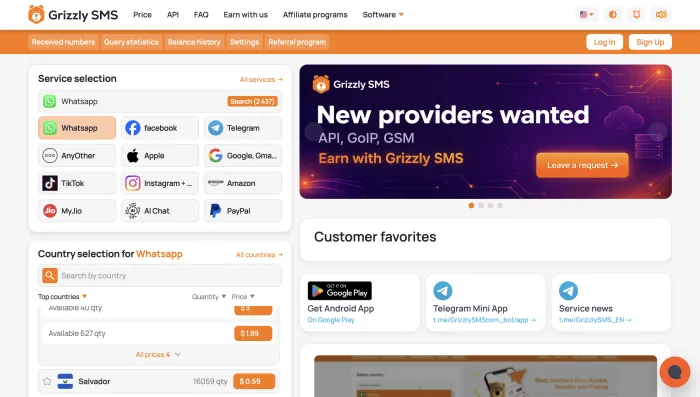
Grizzly SMS is an online service that provides virtual phone numbers for receiving SMS. You pick a country and a target service (the platform you need a code from), rent a number for a few minutes or longer, and the verification code that gets sent to that number appears in your Grizzly SMS dashboard.
The service operates on a pay-as-you-go model. You top up a balance, then spend it per number or per code. It supports a large catalog of countries and hundreds of services, and offers both short-term one-time numbers and longer rentals. There's a web dashboard, an Android app (the APK people search for), and an API for programmatic use.
It's one of dozens of services in the "SMS activation" or "virtual number" category, alongside competitors like SMS-Activate, 5SIM, SMSCode, and others. Grizzly SMS is positioned toward the lower-cost end of that market.
How Grizzly SMS Works
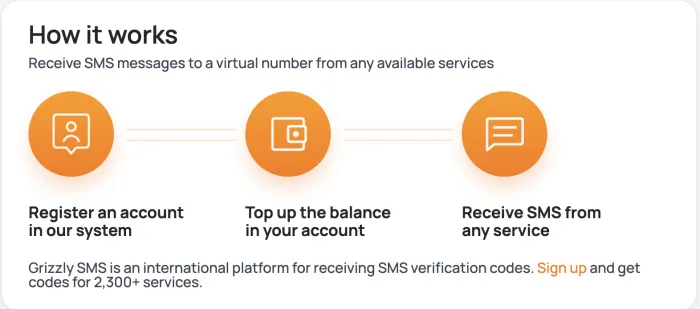
The basic flow is straightforward:
- Create an account and top up a balance using a supported payment method (the service accepts various options including crypto).
- Choose the service you need a code for and the country you want the number from. Pricing varies by both — numbers for high-demand services and premium countries cost more.
- Receive a temporary number and use it on the target platform's signup or verification screen.
- The incoming SMS code appears in your Grizzly SMS dashboard, usually within seconds to a couple of minutes.
- You're charged only on success for one-time activations — if no code arrives, most activations are refunded to your balance.
For longer needs, you can rent a number for hours or days to receive multiple messages, which costs more than a single activation.
How Much Does Grizzly SMS Cost?
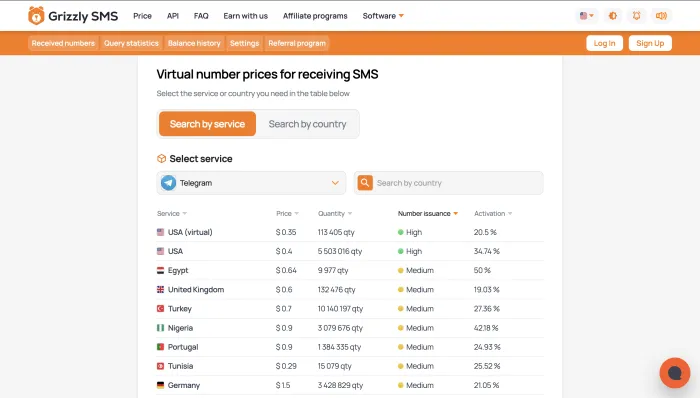
Pricing is per-number and per-service rather than a flat subscription, which is the main appeal — you only pay for what you use.
Individual activations typically range from a few cents to well under a dollar for common services, with prices rising for high-demand platforms and scarce country stock. Longer rentals cost more. Because pricing is dynamic and stock-dependent, the number you see at checkout is the number that applies at that moment.
There's no monthly fee and no minimum contract, which makes it cheap to try. "Grizzly SMS free" is a common search, but the service isn't free — the confusion usually comes from the low per-code cost and occasional promotional balance. Treat it as a low-cost paid tool, not a free one.
Does Grizzly SMS Actually Work?
For its core function — receiving a verification code on a temporary number — yes, it generally works. Codes arrive quickly for well-supported services, and the pay-on-success model means you're not charged when a number fails to receive.
The honest caveats:
Stock fluctuates. Numbers for the most popular services and countries sell out, so availability isn't guaranteed at any given moment.
Some platforms detect and block virtual numbers. Major services actively maintain blocklists of number ranges known to belong to SMS-activation providers. When a platform recognizes a Grizzly SMS number as virtual, it may reject it at signup or flag the resulting account. This is outside Grizzly SMS's control and affects every service in this category.
Reliability varies by target service. A number that works flawlessly for one platform may fail repeatedly on another that has tighter detection.
Where Grizzly SMS Is Legitimately Useful
There are real, above-board reasons to use a virtual number:
Protecting your real number on one-time signups. If a site demands a phone number just to download a file or claim a one-time offer and you don't trust it with your real one, a disposable number is a reasonable privacy measure.
Marketplace and classifieds privacy. When listing an item for sale publicly, a temporary number keeps your personal line off the open internet.
Developer and QA testing. If you're building an app with SMS verification, virtual numbers let you test the flow across countries without buying physical SIMs.
Avoiding spam exposure. For any signup you expect will sell your number to marketers, a throwaway number contains the damage.
In all of these, you're using one number for one legitimate purpose — not evading a platform's identity controls.
The Account-Ban Risk Nobody Mentions
Here's what promotional reviews leave out, and it's the most important thing to understand.
The most common reason people search for services like Grizzly SMS is to create multiple accounts on platforms that enforce one-account-per-number — WhatsApp, Instagram, Telegram, Google, and similar. This is where the risk is highest, and it runs in three directions:
It usually violates the platform's terms of service. Most major platforms explicitly prohibit creating accounts to evade their one-person-one-account rules. Doing so puts any account created this way at risk of suspension without notice.
Virtual numbers are increasingly detected. Platforms buy the same data that identifies SMS-activation number ranges. An account verified with a flagged number can be banned immediately or shadow-limited later, even after it seems to work.
You lose the account and anything tied to it. Because you don't own the number — it was rented for minutes — you can't recover the account if the platform later asks you to re-verify. The number is gone, and so is the account.
If your intended use is bulk account creation on a major platform, understand that you're accepting a real chance of losing those accounts, and that the activity breaches the platform's rules. This review won't walk through how to do that, because the honest answer is that it's a fragile and rule-breaking approach, not a reliable growth tactic.
Is Grizzly SMS Safe?
On technical safety, the service is a normal, functioning commercial website with an app and API. The bigger safety considerations are about how you use it:
Never receive codes for accounts that matter to you. A rented number is temporary and shared over time. Don't use one for your primary bank, primary email, or any account you can't afford to lose access to — if you ever need to re-verify, the number won't be yours.
Understand the number is not private to you forever. After your rental ends, the number returns to the pool and can be assigned to someone else. Anything still tied to it is exposed.
Use a dedicated payment method. As with any pay-as-you-go service accepting crypto, keep the balance small and don't link it to sensitive financial accounts.
The service itself isn't a malware or phishing operation. The risk is situational: it's safe for disposable, low-stakes verification and unsafe as the phone number behind anything important.
Grizzly SMS vs Alternatives
Grizzly SMS competes in a crowded category. Quick context on how it sits:
Grizzly SMS — low-cost, broad country and service catalog, app and API, pay-on-success. A reasonable budget option.
SMS-Activate / 5SIM — the largest and most established players, with bigger stock and higher reliability for hard-to-get services, often at slightly higher prices.
SMSCode — a direct competitor positioned similarly on price.
Twilio Verify — a fundamentally different, legitimate, enterprise-grade product. If you're a business that needs to sendverification to your own users (rather than receive codes on disposable numbers), Twilio is the correct tool and the two aren't really substitutes. The presence of "Grizzly SMS vs Twilio" comparisons in search results reflects confusion between two very different use cases: consumer disposable numbers versus business verification infrastructure.
Choose based on the real job: disposable one-time verification (Grizzly SMS and its direct peers) versus sending verification to your own customers (Twilio, MessageBird, and similar).
Who Should and Shouldn't Use It
Reasonable fit: anyone who needs a throwaway number for a one-time, low-stakes signup; developers testing SMS flows; sellers protecting a personal number on public listings.
Poor fit / high risk: anyone trying to mass-create accounts on major platforms (ban risk plus ToS violation); anyone tempted to use it for a bank, primary email, or any account they can't lose; any business that actually needs to send verification to customers (use a proper provider instead).
Verdict
Grizzly SMS is a legitimate, functional, low-cost virtual number service. It does what it says for disposable SMS verification, and for privacy-protective, one-time, low-stakes uses it's a sensible tool.
The catch is that the most popular use for services like this — spinning up multiple accounts on platforms that forbid it — is exactly where it's riskiest. Those accounts violate platform rules, get detected and banned with increasing frequency, and can't be recovered once the rented number is gone. If you go in understanding that boundary, Grizzly SMS is a cheap and capable tool for the narrow set of things it's genuinely good at. Use it for disposable verification, never for anything you can't afford to lose, and don't build anything important on a number you don't own.
FAQ
Is Grizzly SMS legit?
Yes, it's a real, functioning virtual number service, not a scam. It provides temporary numbers across many countries and charges only when a code is successfully received for one-time activations. Whether it's the right tool depends on your use case — it's fine for disposable verification and risky for creating accounts on platforms that prohibit multiple accounts.
Is Grizzly SMS free?
No. It's a low-cost paid service with no subscription — you top up a balance and pay per number or per code. Individual activations often cost only a few cents, which is likely why "free" is a common search, but a real balance is required.
Is Grizzly SMS safe to use?
The service itself is a normal commercial website and app, not malware. The safety risk is situational: never use a rented number for accounts that matter (bank, primary email), because the number is temporary and returns to a shared pool after your rental ends. Use it only for disposable, low-stakes verification.
Can I use Grizzly SMS for WhatsApp or Instagram?
Technically it can receive codes for these platforms, but doing so to create additional accounts violates their terms of service and carries a high ban risk. These platforms increasingly detect virtual numbers and can suspend the resulting accounts without notice. Because you don't own the number, a banned or re-verification-locked account can't be recovered.
Does Grizzly SMS have an app?
Yes, there's an Android app (the APK that appears in searches) and an API for programmatic use, alongside the web dashboard. Use the official site or Google Play listing rather than third-party APK mirrors to avoid tampered versions.
What's the difference between Grizzly SMS and Twilio?
They solve opposite problems. Grizzly SMS gives you disposable numbers to receive codes. Twilio Verify is enterprise infrastructure for businesses to send verification to their own users. If you run a service that needs to verify customers, Twilio is the correct choice; the two aren't interchangeable.
How much does Grizzly SMS cost?
Pricing is per-number and per-service with no monthly fee. Common activations range from a few cents to under a dollar, rising for high-demand services and scarce countries. Longer rentals cost more. The price shown at checkout reflects live stock and demand.